

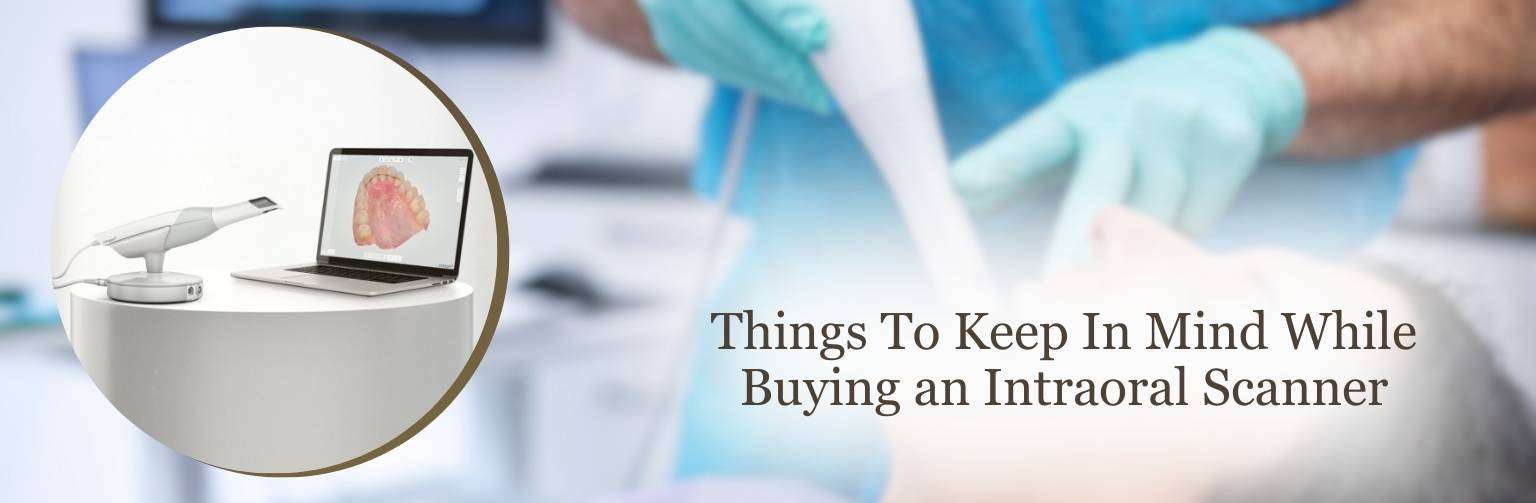
Things To Keep In Mind While Buying an Intraoral Scanner
A negative impression of an oral structure is utilized to manufacture a dental restoration or prosthesis. For producing dental restorations that fit properly, a precise impression is required. Misalignment of the prosthesis due to an incorrect impression causes mechanical or biological complications. For precision, many impression techniques with advanced materials are introduced.

The advancements of digital dentistry have not only popularized the ideas of computer-aided design (CAD) and computer-aided manufacturing (CAM), but it has also made it possible to achieve more effective and predictable diagnostic accuracy.
As an alternative to traditional impressions, which are often poorly tolerated by patients, an increasing number of dentists are obtaining and adopting intraoral scanners (IOS) for making optical impressions of oral soft & hard tissues.
Digital dentistry is now on the rise, dentists are increasingly requesting digital intraoral scanners, and patients are requesting digital scans as well.

Problems with conventional Impression Making:

- Unpleasant patient experience with impression material
- Gag reflex with patient
- Material early / delay setting
- Model breaking
- Multi-handling of impression leads to infection spreads etc.

Intra-oral Scanner Benefits:
- Less human contact, reduce infection spread
- Accurate digital impression
- Good patient experience
- Early diagnostic tools
- Time-saving
- Cost on material saving etc.
7 Things Before Buying An Intraoral Scanner:
Now that dentists want to upgrade to a digital intraoral scanner, they must keep a few things in mind before investing in one. Because it is such a large investment, dentists must understand all aspects of the intraoral scanner.
A scanner must be fast
The main and important reason for purchasing a scanner is to reduce the chairside time of impression making. So, an Intraoral scanner must be Fast at the speed of capturing an image so that dentist can scan the dental impression in less time.

Widely Accepted by all Digital dental Labs
The important thing to keep is that the intraoral scanner you looking for must be an open system. It has been observed that there is some scanner they provide close file format, which is not accepted by the open digital lab. So always keep in mind that your scanner should export open file format so that it can be widely accepted by the all-digital cad cam lab.
It should be Portable
Many dentists are nowadays doing multiple visiting consultancies. Trios Color Pod Intraoral Scanner should also be portable from one place to other so that dentists can make an impression for their cases anywhere. It should be easy to carry.

Should Produce Images of High Accuracy
A Trios 4 Intraoral Scanner should capture high-quality digital impressions. We offer accuracy of up to 8 microns, which is 1/10 the width of a human hair, and accuracy should never be more than 20 microns.

It Should Produce Real Colours
Your intraoral scanner must provide you real color 3D Images. So that dentists can have a look for the real color image for the best use of doing diagnostic purposes. Nowadays some scanners provide even shade measurement also for the better use of intraoral scanner

Powder-free Scanner
One should always take care before buying an intraoral scanner that scanner must be powder-free / spray-free. The dentist should not apply any special contrast powder/spray for scanning of the oral cavity as doing the same will increase the inaccuracy of the digital impression. The powder-free scanner is always better.

Anti-Fogging Feature
Every Trios intraoral scanner should have an anti-fogging feature. This is essential because there is considerable moisture inside the mouth which fogs mirrors and lenses. A dentist who uses an intraoral scanner with an anti-fogging feature can confidently create a digital impression without worrying that fog will lead to impressions of poor quality.

And the most important thing is Backed Support
It is a significant investment. It should only be purchased from reputed companies that can train dentists on how to use them and give backend support. Without knowing how to use an intraoral scanner, a dentist may inadvertently damage it, making such training essential. A backend support team is also essential because should any problems arise they can solve them quickly.
Conclusion
Keeping the following above-mentioned things in mind before buying the Intraoral scanner will help you to provide the best quality and quantity work to your patient. You will have a good experience while making the digital scan along with the digital accuracy of the intraoral scanning also. While will increase your workflow and help dental professionals also.
Unicorn DenMart limited is one of the leading dental equipment companies which provides all highly rated dental equipment in India. They are having TRIOS 3 Wireless intraoral scanner which is a Denmark-based company. 3shape trios is the No 1 in Intraoral scanner providing all services with digital accuracy with real images, now 3shape has all excitement apps such as Smile design, treatment simulator, etc.

Leave a comment