

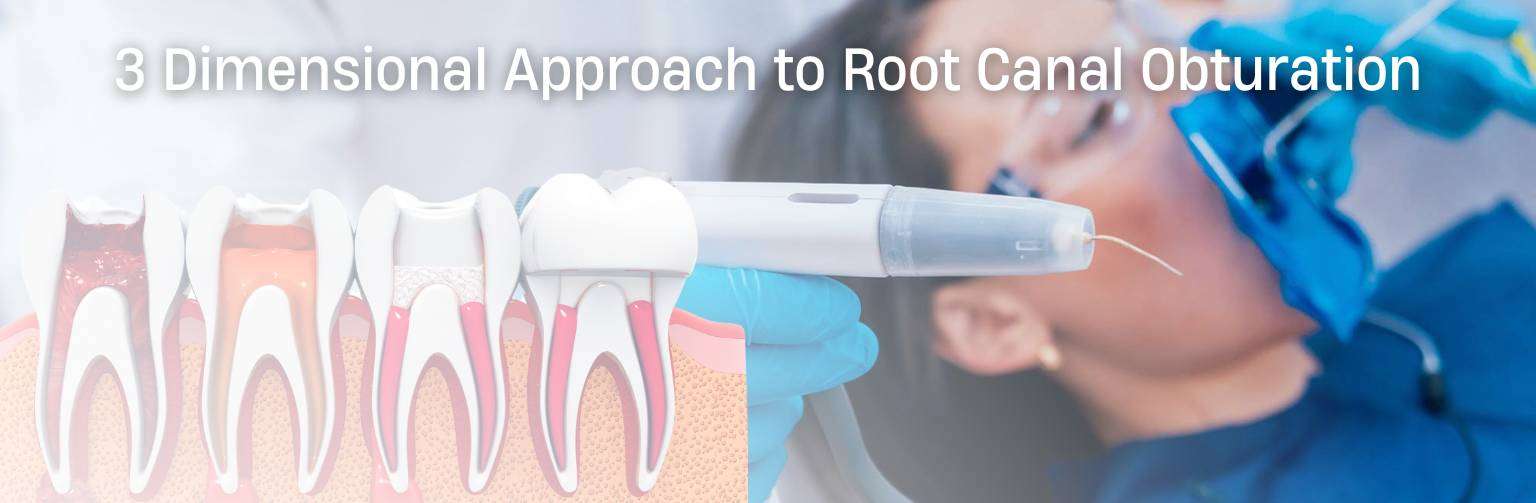
3 Dimensional Approach to Root Canal Obturation
By – DR VAIBHAV GUPTA
Introduction:
The root canal system is one of the most variable & complex systems to work with. The goal of Root Canal Treatment is to get rid of the invading microorganisms completely and to achieve the perfect Apical & Coronal seal after thorough cleaning & shaping of the root canal systems. Inadequate obturation and unsuccessful achievement of Coronal, as well as Apical seal, leads to failure of Endodontic Treatment leading to Periapical infections which in turn leads to loss of alveolar bone & may be loss of a tooth as well.
It is very difficult to achieve proper 3-dimensional root canal fill using conventional obturation techniques like WVC, WLC, or Single Cone Technique in various tooth root anatomies e.g. C Shaped Canals, Wide Distal Canals in Mandibular Molars, Palatal canals in Maxillary Molars, variable furcations of Premolar Root systems and in wide oval canals of Maxillary Interiors. In such cases we need to use an obturation technique that can fill the space of the canal in 3 dimensional way, that is why the Warm Flowable GP Technique is one of the most reliable methods to achieve the desired result and to create a perfect coronal and apical sealing of the root canal system.
CASE 1 :
A 12-year-old reported to the clinic with a history of RTA & Fractured crowns i.r.t. #11, #12 & #21 with pain in all 3 teeth. Radiograph revealed open apex in all 3 teeth along with periapical radiolucency i.r.t. #11 & #21. Clinically all 3 teeth were T.O.P. +ve. Root canal treatment was done with 3 weeks Calcium Hydroxide intracanal dressing protocol to get rid of apical infection followed by proper irrigation protocol & MTA Plugging to create Apical Stop before obturation. Final Obturation was done using GENESYS Warm GP Flow Technique.
Case 2:
A 19-Year-Old patient reported to the clinic with an immediate history of RTA & Subluxation of teeth #11 & #21 and Avulsion of #12. The radiograph revealed a closed apex. Implant i.r.t. #12 and Root canal treatment was done using proper irrigation protocol & obturation was done with 2 step Obturation method using master cone for Apical Sealing and GENESYS Warm GP Flow Technique for mid & coronal sealing.

Leave a comment